PTE Core Respond to a Situation Template & Tips | Lengqishui
Use a flexible PTE Core Respond to a Situation template, examples and a 20-second preparation method for appropriacy, pronunciation and fluency.
Product interface
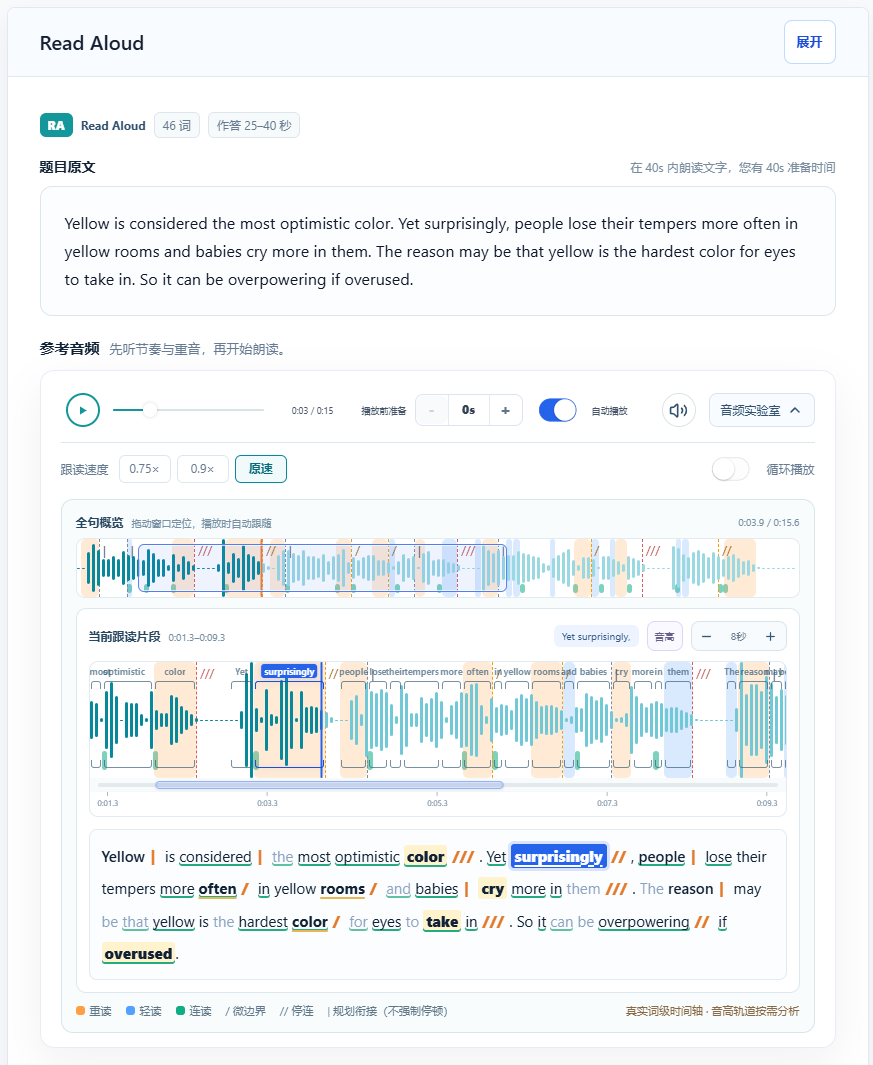
Real Lengqishui Read Aloud reference-audio interface. The annotations describe the reference audio, not a learner recording or an official Pearson score.
Original RTS Practice with Point-by-Point Response Evidence
Practise a request to a friend, a workplace apology and a service complaint with three original fictional situations. Plan independently, then compare relationships, preparation cues, English responses, coverage evidence and errors.
Original example 1 · RTS
Ask a friend to change a plan while respecting a time limit
Prompt 55 words · Model response 77 words
An informal request. Explain why the original time no longer works, propose a change for confirmation and keep the ride within your friend’s schedule.
Complete English situation prompt
You and your friend Leo planned to cycle together on Sunday at 9 am. Your bicycle needs repairs until noon. You can meet at 2 pm instead, but Leo must be home by 5 pm. Ask Leo to change the plan, explain why, and suggest a ride that fits his schedule. What would you say?
Response & preparation notes
Relationship and constraints
You are speaking directly to your friend Leo. A friendly, natural register fits, but the new arrangement still needs his agreement.
The original plan is Sunday at 9 am; the bicycle is under repair until noon.
You can meet at 2 pm; Leo must be home by 5 pm.
Propose a ride within the time limit and check whether it suits him rather than announcing a completed change.
20-second preparation cues
Listener and tone: friend Leo; friendly and considerate.
Reason: bicycle repairs until noon make 9 am impractical.
Plan: ask about 2 pm; propose a shorter route ending at 4 pm.
Action: check agreement; being home by 5 pm remains a constraint.
One possible English response
Hi Leo, could we move Sunday's bike ride from nine in the morning to two in the afternoon? My bike is being repaired and won't be ready until noon. I'm sorry for changing our plan at short notice.
Since you need to be home by five, we could take the short riverside route and finish by four. That should leave you time to get back.
Would that work for you, or would you rather choose another day?
This is one possible response, not the only answer. People, times and solutions must fit the current prompt. Clarity, continuous delivery and actual duration need review of an independent recording.
Why this tone fits
Hi Leo and could we suit a request between friends. A brief apology acknowledges the inconvenience, while Would that work for you leaves room to accept, adjust or choose another day.
An unsuitable response and a correction direction
Avoid this response
I've changed our ride to two. We'll do the long lake route and get back at six. You can tell your family you'll be late.
This treats the change as agreed and moves the return to 6 pm, violating the 5 pm home-time limit. Telling the friend to deal with being late also undermines the considerate request.
Relevant correction from the model
Would that work for you, or would you rather choose another day?
Check each situation requirement
Task point 1
Explain why the original Sunday 9 am plan does not work.
Exact prompt evidence
You and your friend Leo planned to cycle together on Sunday at 9 am. Your bicycle needs repairs until noon.
Exact evidence from the model response
My bike is being repaired and won't be ready until noon.
Repairs continuing until noon explain why the 9 am plan no longer works. The reason comes from the prompt and does not put responsibility for the change on Leo.
Task point 2
Ask Leo to meet at 2 pm instead without assuming agreement.
Exact prompt evidence
You can meet at 2 pm instead, but Leo must be home by 5 pm. Ask Leo to change the plan, explain why, and suggest a ride that fits his schedule.
Exact evidence from the model response
Hi Leo, could we move Sunday's bike ride from nine in the morning to two in the afternoon?
This identifies both the original time and the proposed 2 pm alternative. Could we makes it a request rather than an unapproved decision; the closing also checks whether the plan suits Leo.
Task point 3
Suggest a ride that allows Leo to be home by 5 pm.
Exact prompt evidence
Leo must be home by 5 pm. Ask Leo to change the plan, explain why, and suggest a ride that fits his schedule.
Exact evidence from the model response
Since you need to be home by five, we could take the short riverside route and finish by four. That should leave you time to get back.
This keeps the 5 pm home-time limit and proposes a shorter ride finishing at 4 pm, leaving a margin for travel. It is a fictional proposal to confirm together, not a guarantee about a real route or journey time.
Review after an independent recording
After collapsing the reference section, did you prepare from the prompt alone and record independently instead of reading the model aloud?
Did your response explain the repairs, ask about 2 pm and preserve the requirement to be home by 5 pm?
Did you present the route and finish time as a proposal rather than an arrangement Leo has already accepted?
Replay your recording to mark long pauses, repetition and unclear segments. Check actual duration from that recording, not from the model’s word count.
Try a different friend and time limit, then record again to check whether you can adapt rather than only remember this example.
Original example 2 · RTS
Apologise to a supervisor and replace an unreliable report
Prompt 58 words · Model response 81 words
A workplace apology with a remedy. Own the use of old figures, give a specific correction time and prevent continued use of the wrong version.
Complete English situation prompt
You promised to send your supervisor, Ms Chen, a stock report by 11 am today. You accidentally used last month's figures and noticed after sending it. The corrected report can be ready by 1 pm. Apologise, explain the error and how you will correct it, and ask her not to use the first report. What would you say?
Response & preparation notes
Relationship and constraints
You are telling your supervisor, Ms Chen, about an error you made. A professional, accountable and cooperative register fits; do not shift the responsibility to someone else.
The report was due by 11 am today; the incorrect version has already been sent.
The error is using last month’s figures, not an unfinished report or figures supplied incorrectly by the supervisor.
The corrected report can be ready by 1 pm today; the supervisor should not use the first version.
20-second preparation cues
Listener and tone: supervisor Ms Chen; professional and accountable.
Apology and error: I used last month’s figures; the sent report is unreliable.
Remedy: use this month’s figures, check totals and send a clearly labelled correction by 1 pm today.
Action: ask her to disregard the first version; notify her when the correction is ready.
One possible English response
Ms Chen, I'm sorry about the stock report I sent you. I accidentally used last month's figures instead of the current ones, so the report is not reliable.
I'll replace them with this month's figures, check the totals, and send a clearly labelled corrected report by one this afternoon.
Could you please disregard the first version and wait for the corrected report? I realise this may delay your planning, and I'll message you as soon as the corrected report is ready.
This is one possible response, not the only answer. People, times and solutions must fit the current prompt. Clarity, continuous delivery and actual duration need review of an independent recording.
Why this tone fits
The address, apology and clear remedy respect the supervisor. Acknowledging a possible planning delay recognises the impact without exaggerating it or dismissing the error as trivial.
An unsuitable response and a correction direction
Avoid this response
Someone must have sent me the wrong numbers. Just use the report for now. I'll fix it sometime tomorrow.
This invents another person as the source of the error, encourages use of an unreliable report and delays the correction until tomorrow. All three conflict with the prompt, while the apology and ownership are missing.
Relevant correction from the model
Could you please disregard the first version and wait for the corrected report?
Check each situation requirement
Task point 1
Apologise and explain that the sent report used last month’s figures.
Exact prompt evidence
You accidentally used last month's figures and noticed after sending it. The corrected report can be ready by 1 pm. Apologise, explain the error
Exact evidence from the model response
Ms Chen, I'm sorry about the stock report I sent you. I accidentally used last month's figures instead of the current ones, so the report is not reliable.
This gives a direct apology and identifies both the use of last month’s figures and the resulting unreliable report. I accidentally used owns the error without inventing a colleague to blame.
Task point 2
Explain how you will correct the report and provide it by 1 pm today.
Exact prompt evidence
The corrected report can be ready by 1 pm. Apologise, explain the error and how you will correct it
Exact evidence from the model response
I'll replace them with this month's figures, check the totals, and send a clearly labelled corrected report by one this afternoon.
The remedy specifies replacing the figures, checking totals, labelling the version and delivering it by 1 pm today. The checking steps are a plan for future action, not a claim that testing has already been completed.
Task point 3
Ask Ms Chen not to use the first report.
Exact prompt evidence
ask her not to use the first report.
Exact evidence from the model response
Could you please disregard the first version and wait for the corrected report?
This explicitly asks the supervisor not to use the wrong version rather than merely promising another email. Wait for makes clear that the replacement is still being prepared, not already delivered.
Review after an independent recording
Collapse the reference section, prepare from the prompt and record independently. Are you speaking to Ms Chen rather than retelling the situation?
Did you apologise and accurately explain the use of last month’s figures without inventing someone else’s responsibility?
Does the remedy include checking actions, today’s 1 pm deadline and a request not to use the first version?
Replay your recording to check the connection between apology, remedy and request, marking hesitations or unclear words. Written evidence cannot replace this review.
Check actual speaking time from your recording, then practise a different workplace error and deadline. Do not treat the model’s word count as an official duration or score standard.
Original example 3 · RTS
Make a polite complaint and ask for a usable quiet space
Prompt 57 words · Model response 79 words
A complaint to an unfamiliar service worker. Explain the problem with specific facts, keep the goal of using the booking and ask about a workable solution.
Complete English situation prompt
You booked a quiet study room at a community centre from 3 to 5 pm today. Loud music from the next room makes it difficult to study. You need a quiet space until 5 pm and do not want to cancel. Explain the problem to the receptionist and ask for a suitable solution. What would you say?
Response & preparation notes
Relationship and constraints
You are a customer speaking to an unfamiliar receptionist about your study-room booking. Be polite and specific, separating the known noise problem from unverified motives.
The booking is today from 3 to 5 pm; music from the next room is the source of the noise.
You still need a quiet space until 5 pm and do not want to cancel.
Ask for a workable solution; the prompt does not guarantee another room is available or ask for a refund.
20-second preparation cues
Listener and tone: receptionist; polite and specific.
Problem: a 3–5 pm study-room booking; next-door music disrupts concentration.
Constraint: a quiet space is needed until 5 pm; keep the booking.
Action: ask about reducing the music or another quiet room for the remaining time.
One possible English response
Hello, I booked a quiet study room here from three to five this afternoon. There's loud music coming from the next room, and I'm finding it difficult to concentrate.
I still need a quiet place until five, so I'd prefer to keep my booking rather than cancel.
Could you please check whether the music can be reduced or offer another quiet room for the remaining time? I'd appreciate your help finding an option that lets me finish studying today.
This is one possible response, not the only answer. People, times and solutions must fit the current prompt. Clarity, continuous delivery and actual duration need review of an independent recording.
Why this tone fits
Hello, Could you please and the appreciation fit an unfamiliar service worker. The request is clear without attacking the listener or demanding a refund that conflicts with keeping the booking.
An unsuitable response and a correction direction
Avoid this response
Your centre is useless. Cancel my booking and refund everything now. I do not care about getting another room.
This changes the goal from obtaining a quiet space to cancelling and seeking a refund, directly contradicting the prompt. A hostile generalisation also does not help the receptionist identify and resolve the noise problem.
Relevant correction from the model
I still need a quiet place until five, so I'd prefer to keep my booking rather than cancel.
Check each situation requirement
Task point 1
Identify the study-room booking and explain the noise problem.
Exact prompt evidence
You booked a quiet study room at a community centre from 3 to 5 pm today. Loud music from the next room makes it difficult to study.
Exact evidence from the model response
Hello, I booked a quiet study room here from three to five this afternoon. There's loud music coming from the next room, and I'm finding it difficult to concentrate.
The room purpose and 3–5 pm time identify the service, followed by the effect of next-door music on concentration. This describes the problem without accusing the receptionist of causing it deliberately.
Task point 2
Explain that you need a quiet space until 5 pm and do not want to cancel.
Exact prompt evidence
You need a quiet space until 5 pm and do not want to cancel.
Exact evidence from the model response
I still need a quiet place until five, so I'd prefer to keep my booking rather than cancel.
This preserves both constraints: needing a quiet place until 5 pm and not wanting to cancel. The complaint aims to continue studying rather than cancel the booking and seek compensation.
Task point 3
Ask the receptionist for a suitable solution.
Exact prompt evidence
Explain the problem to the receptionist and ask for a suitable solution.
Exact evidence from the model response
Could you please check whether the music can be reduced or offer another quiet room for the remaining time?
This asks about two possible remedies: reducing the music or arranging another quiet room. Check whether does not assume the receptionist can immediately stop the music, and another room is a request rather than a claim of confirmed availability.
Review after an independent recording
After collapsing the reference section, prepare and record from the prompt alone. Are you complaining directly to the receptionist rather than describing how you would complain?
Did you identify the booking period and the effect of the music, while keeping the need for a quiet space until 5 pm?
Do you still want to keep the booking, and are reduced music or another room requests rather than confirmed arrangements?
Replay your recording to check whether the request is clear and whether there is hostile delivery, repeated correction or a long pause. Do not judge spoken performance from text alone.
Check actual duration from your recording, then practise a different service problem independently. This card does not time, record, save or score a response.
PTE Core Respond to a Situation format and timing
Listen to and read an everyday prompt of up to 60 words, prepare for 20 seconds and speak for 40 seconds. Respond as the person in the situation instead of summarising the prompt.
Use a flexible purpose–points–action template
Identify the listener and relationship, state the request, apology, explanation, complaint or suggestion, cover the required details and end with the desired action. Replace every element with prompt-specific information.
Appropriacy comes before a polished memorised answer
Pearson scores appropriacy, pronunciation and fluency. Check relevance, politeness and formal or informal register first, then review clarity, pace, pauses, phrasing and stress.