Free PTE Core Repeat Sentence Practice & Tips | Lengqishui
Practise PTE Core Repeat Sentence for free with one-play audio, phrase memory, correct word sequence, shadowing, pronunciation and oral-fluency tips.
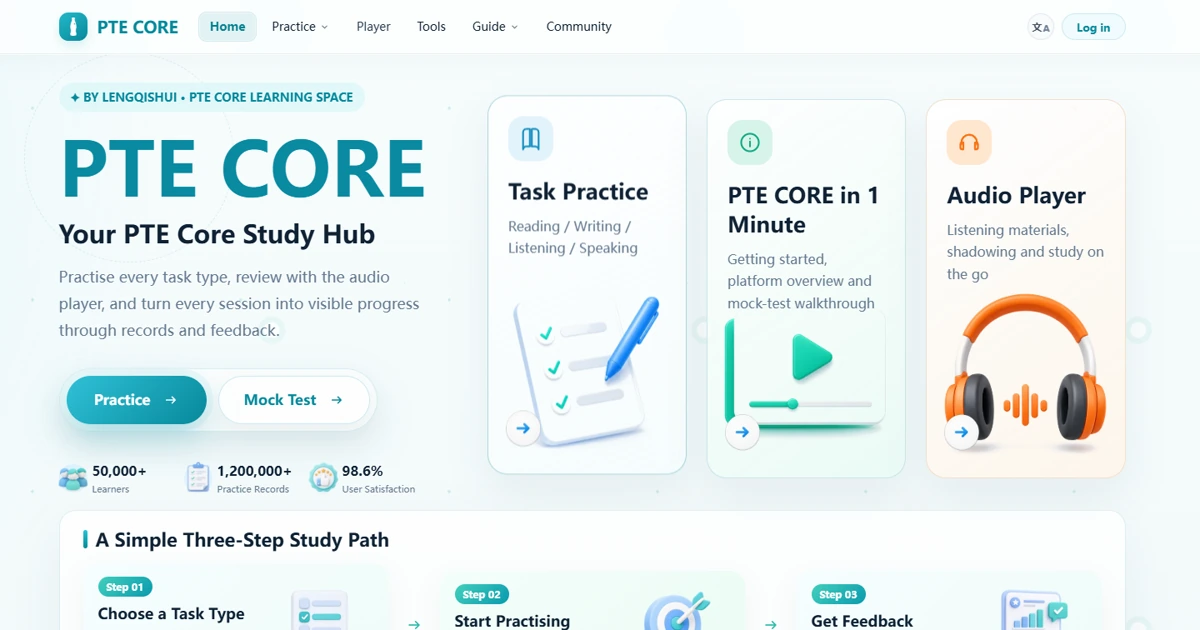
Product interface
Real Lengqishui English homepage with the Audio Player entry for listening, shadowing and Repeat Sentence review.
PTE Core RS: Original Repeat Sentence Comparisons
Use three written comparisons to inspect replacements, missing negation and reordered groups, then choose one specific check for your next recorded-audio practice item.
The three sentences, hypothetical responses and explanations are AI-assisted original fictional examples without human expert review. They are not Pearson test questions, real learner results or official scoring. They are written comparisons, not a one-play listening test; text alone cannot judge pronunciation, oral fluency or an official score. The grouping is only an optional practice approach, not a fixed answer or a compulsory pause pattern. These cards do not record, automatically score or save a response.
Replacement: similar meaning is not the original wording
Expand the original, hypothetical response and repair
Complete original English sentence
Please leave your coat by the entrance before the meeting starts.
One optional grouping
Please leave your coat / by the entrance / before the meeting starts.
The slashes show one optional grouping. They are not sentence words or compulsory pauses; preserve the original sequence when comparing.
Hypothetical response (not an actual learner recording)
Please leave your coat near the entrance before the meeting starts.
Exact differences
Original contentbyHypothetical contentnear
The original uses by; the hypothetical response uses near. Their meanings are similar here, but near is still a replacement. RS recall is not a paraphrase of the sentence.
Difference evidence and limits
The replacement occurs in the by the entrance group. The surrounding words keep their order. This written comparison establishes the by/near difference, not whether it came from listening, memory or an improvised paraphrase.
One repair action
Read by the entrance as a complete group, put the text away and recall its exact wording. This is text-assisted review, not a listening test; do not replace by with the similar word near.
Check a new recording after one play
Choose a new RS recording whose transcript you have not seen. Play it once, recall it independently, then reveal the transcript and check for replaced prepositions. Replay only during review; memorising this sentence does not establish better listening on a new one.
Missing negation: do not turn an exemption into a requirement
Expand the original, hypothetical response and repair
Complete original English sentence
You do not need to bring the printed form on Tuesday.
One optional grouping
You do not need to bring / the printed form / on Tuesday.
The slashes show one optional grouping. They are not sentence words or compulsory pauses; preserve the original sequence when comparing.
Hypothetical response (not an actual learner recording)
You need to bring the printed form on Tuesday.
Exact differences
Original contentdo notHypothetical content(omitted)
The hypothetical response omits do not between You and need. The original says the form is not required; the response makes it a requirement. The remaining grammatical sentence does not remove the omission.
Difference evidence and limits
Compare the opening You do not need to bring before checking later information such as form and Tuesday. The hypothetical text shows a missing negation; it does not establish whether the negative was heard or how clear an actual recording sounded.
One repair action
Read do not need to bring as one meaningful group, put the text away and recall the complete opening. Keep the negative with the action rather than remembering only need and bring.
Check a new recording after one play
Use another new RS recording with its transcript hidden. After one play, recall it independently and check whether negatives, limits or conditions remain. If the sentence has no negative, keep its actual wording rather than adding one for this exercise.
Reordered groups: similar facts are not the original sequence
Expand the original, hypothetical response and repair
Complete original English sentence
The training starts at ten, but the doors open at nine.
One optional grouping
The training starts at ten, / but the doors open at nine.
The slashes show one optional grouping. They are not sentence words or compulsory pauses; preserve the original sequence when comparing.
Hypothetical response (not an actual learner recording)
The doors open at nine, but the training starts at ten.
Exact differences
Original contenttraining starts at ten → doors open at nineHypothetical contentdoors open at nine → training starts at ten
The original gives the training at ten before the doors at nine; the hypothetical response reverses the groups. Similar time facts do not mean that the prompt words remain in their original sequence. The arrows show order and are not spoken content.
Difference evidence and limits
Compare groups from the beginning instead of only ticking off training, ten, doors and nine. The hypothetical response switches to doors immediately after The and also changes the second group. A keyword checklist alone misses this reordering.
One repair action
Read the two complete groups in the original training-then-doors order, then put the text away and recall the sentence. Keep but with the second group; do not reorganise the prompt into chronological order.
Check a new recording after one play
Choose a new RS recording containing two events, hide its transcript and recall it independently after one play. Then check both each event and its sequence before deciding whether to review the groups. Memorising this example does not establish accurate order on a new sentence.
Free PTE Core Repeat Sentence practice with current task facts
Pearson’s January 2026 Score Guide lists 10–12 partial-credit Repeat Sentence questions. Each 3–9 second sentence plays once, the microphone opens without a short tone and the task contributes to listening and speaking.
Content rewards prompt words in the correct sequence
The official content scale awards full credit for all prompt words in sequence, partial credit above or below the 50% threshold and zero when almost nothing comes from the prompt. Pronunciation and oral fluency are separate traits.
Build phrase memory, then review stress and fluency
Store the subject, main verb, negatives, numbers and final phrase in meaningful sound groups. After the one-play attempt, use replay, speed control and shadowing to repair the first broken phrase and reconnect it at a natural rate.
Open Audio Player and select RS (Repeat Sentence). This player is for listening, oral recall and review: it plays reference audio but does not automatically open your microphone or score a spoken response. Use task practice for recording and available feedback.
Select Single question mode, set repetitions to 1, choose 1× speed and hide the transcript. Make sure continuous looping is off. The player can restore saved settings and playback position, so check them before each session. Once the audio and progress control are available, move the progress slider to the start and confirm 0:00 before playing. Single question mode with one repetition stops after the sentence instead of advancing to the next item.
Recall the sentence before revealing the text
Play once and repeat the meaningful phrase groups you remember in their original order. Keep the first attempt separate from replay and transcript help. In the player this is a self-directed oral recall exercise, not a microphone-timed exam response.
Show the transcript and find the first sequence break
After your response, reveal the transcript and check omissions, replacements and word order. Identify the first phrase you lost before deciding what to practise next. A completed playback or saved listening record shows activity, not how accurately you repeated the sentence.
Replay and shadow during review only
Repeat the audio and reduce playback speed if needed to hear a difficult phrase. Shadow its wording, stress and rhythm, then return to 1× speed. Before trying a new sentence, restore one repetition and hide the transcript so review controls do not turn the next recall attempt into assisted reading.
Use Repeat Sentence task practice for recording
Open Practice, choose Repeat Sentence and follow the task’s recording controls. Replay your response and inspect the feedback available for that attempt; do not look for a recording score in the Audio Player. Compare repeated content or delivery problems across attempts. Practice feedback is not an official Pearson result.
Where can I practise PTE Core Repeat Sentence for free?
Use Lengqishui’s Audio Player → RS for listening, self-directed oral recall and repeated review. For an unassisted first attempt, check Single question mode, one repetition, 1× speed and a hidden transcript; saved settings may differ. To record a response and inspect available feedback, use Practice → Repeat Sentence. The player itself does not open the microphone or score your voice.